Teaching an AI to sell like a Bangladeshi shopkeeper.
MyMod is an AI sales assistant for Bangladesh's f-commerce sellers, the hundreds of thousands of shops that live entirely inside Facebook pages. It reads how each buyer types, replies in Bangla, English, or Banglish, answers comments with the right price and stock, captures orders at 2 AM, and hands the hard conversations back to the seller. I built the whole product single-handedly, from first commit to launch.
The idea came from home.
MyMod started with my wife, Ritu. She follows the f-commerce world closely and pointed at a problem hiding in plain sight: sellers in Bangladesh don't run stores, they run conversations. Every product post collects dozens of comments asking price, stock, and delivery. Every sale happens in Messenger. The seller is the storefront, the cashier, and the support desk, and the moment they sleep, the shop closes.
Before writing a line of code, we researched it together: talking through how sellers actually work, what they lose when messages go unanswered overnight, and whether an assistant would genuinely solve a real problem or just add another tool to ignore. The pattern was consistent. Buyers expect replies in minutes, they write in three overlapping languages, and they very often skip words entirely and just send a photo: "eta ache?" Only after that validation did I start building.
Not sounding robotic. And seeing like a seller.
Most of MyMod is disciplined engineering: webhooks, queues, catalog sync. Two problems were genuinely hard, and they are the reason the product works.
What just happened under the hood
The photo is the query
The buyer's image is embedded with a CLIP vision model and matched against the seller's catalog by visual similarity, no product name needed.
The variant is detected
The match resolves to a specific product, then to its option rows: color, size, per-variant stock and price. "Beige" maps to a real inventory row, not a guess.
The reply matches the buyer
The buyer wrote Banglish, so MyMod answers in Banglish, in a warm shopkeeper register. A Bangla buyer gets Bangla; an English buyer gets English.
The seller stays in control
The order is captured as pending. Anything MyMod was never taught gets handed to the seller instead of invented.
A voice that never sounds like a bot.
Bangladeshi buyers can smell an autoresponder instantly, and they disengage just as fast. The bar was not "correct answers," it was answers that read like the seller's own thumb typed them. That is harder than it sounds when the same shop gets "dam koto?", "price?", and "apu ei bag ta koto porbe" within the same hour.
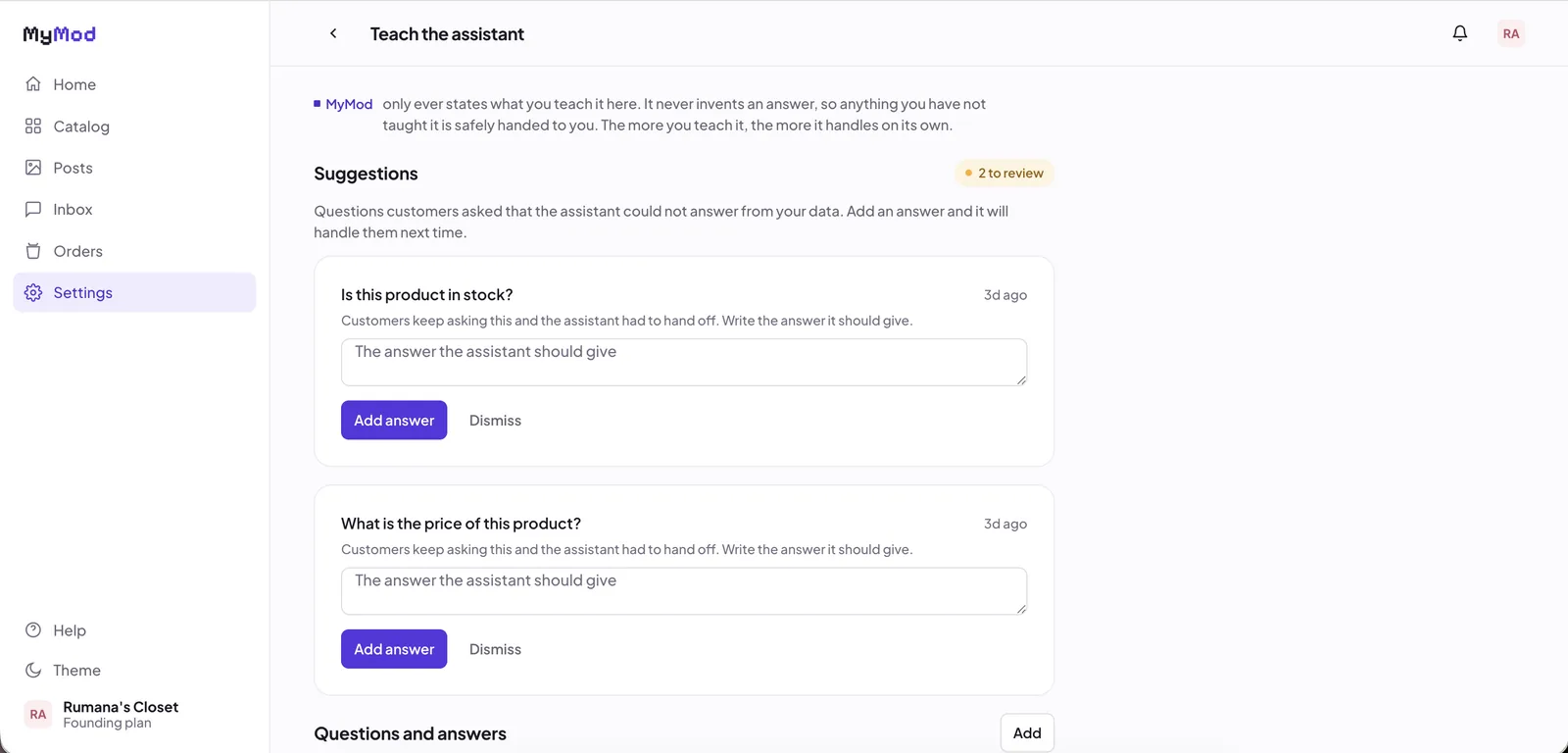
MyMod detects the script and register of each message and mirrors it: language, formality, even the short, direct rhythm of Messenger commerce. Banglish was the hardest of the three, because it is not a language with rules but a habit with dialects; the intent parser had to be built and tuned specifically for how Bangladeshi buyers actually romanize Bangla. The second half of the voice problem is restraint. MyMod only ever states what the seller taught it. When a buyer asks something outside its knowledge, it does not improvise; it hands off to the seller, and the question appears in a review queue so the seller can teach the answer once and never be asked again.
Matching a buyer's photo to the right variant.
The defining behavior of f-commerce buyers is that they shop with screenshots. They save a photo from a post three weeks ago, send it back, and expect the seller to know exactly which bag, which color, which size. For a human seller that is memory. For software it meant building a visual search engine over each shop's own catalog.
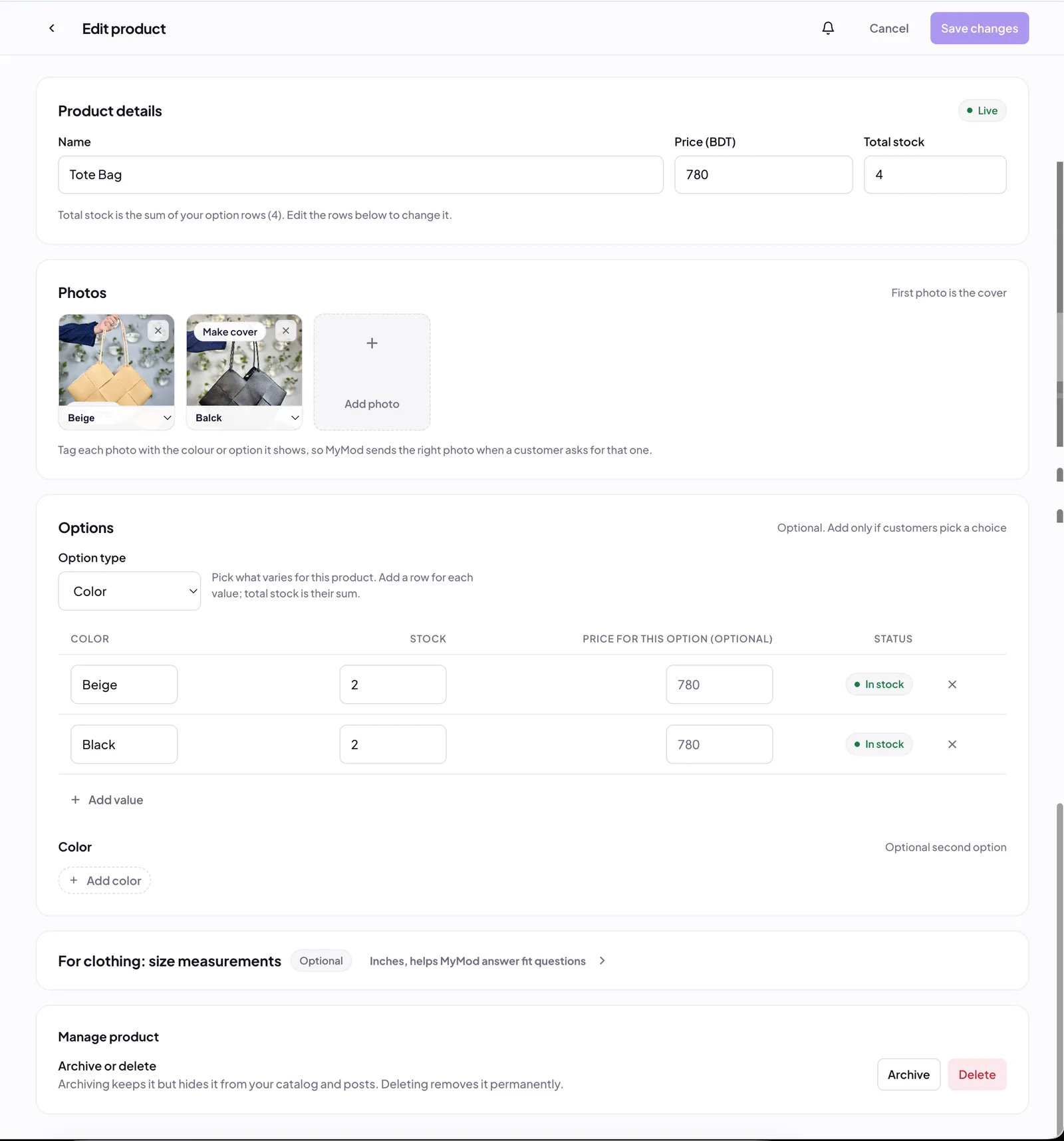
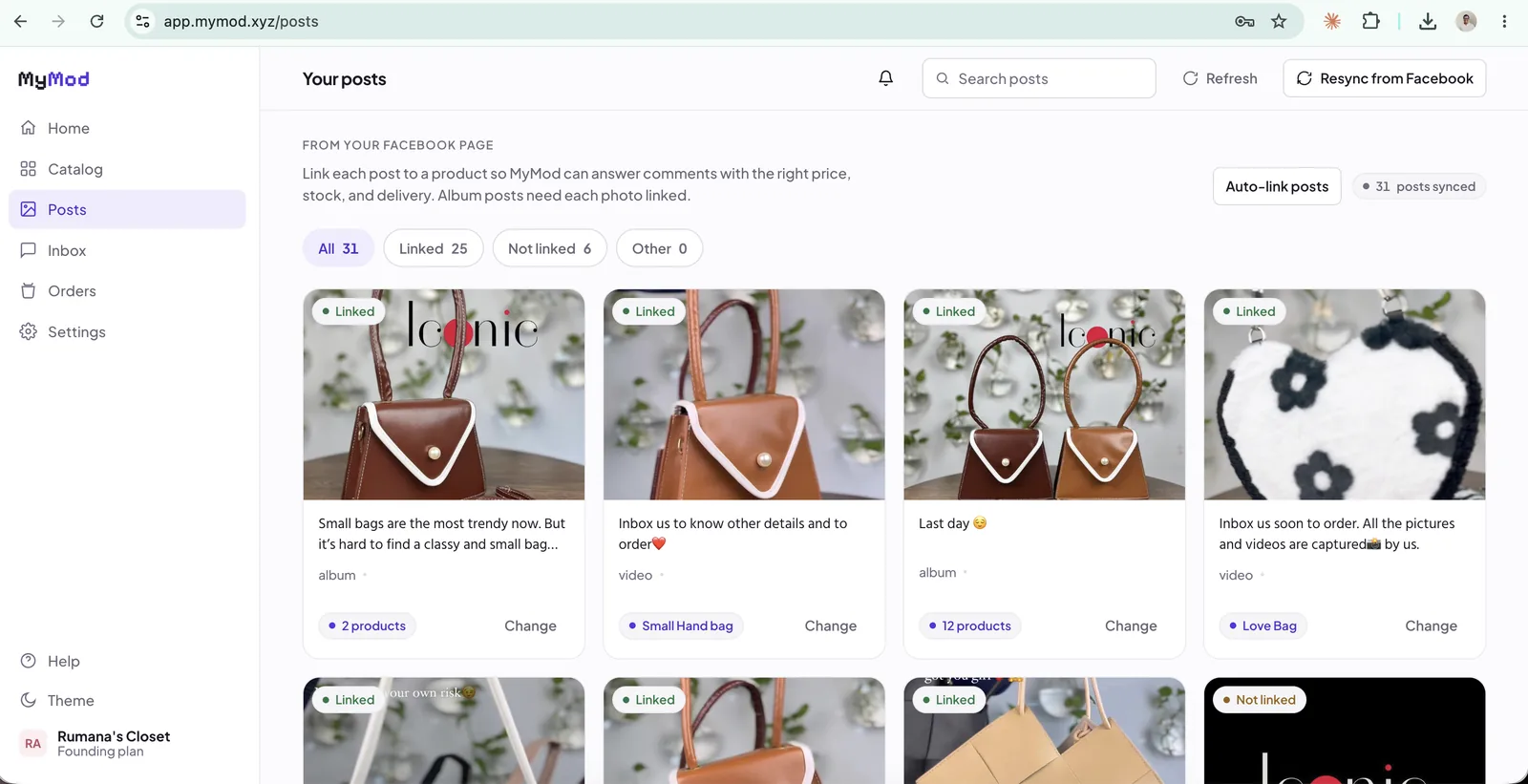
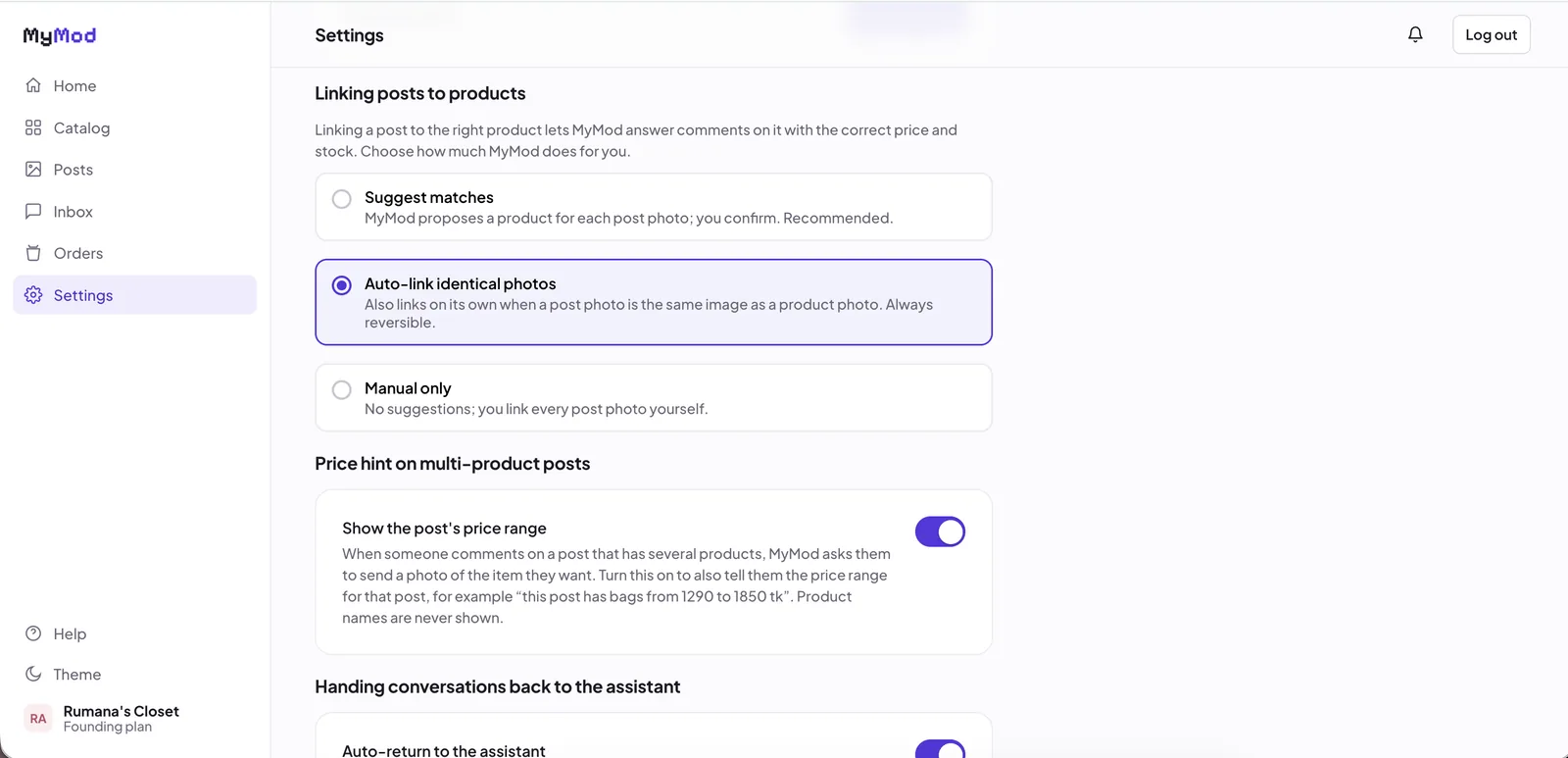
Every catalog photo is embedded with a CLIP model into pgvector, and each photo is tagged to the option it shows, so a beige photo and a black photo of the same bag resolve to different variant rows. When a buyer sends an image, MyMod embeds it, finds the nearest catalog products, confirms with a vision model when the match is ambiguous, and answers with that variant's real price and stock. The same engine links the seller's Facebook posts to products automatically, so comment replies on any post quote the right numbers, and multi-product album posts get a price-range hint instead of a wrong guess.
One person, the whole stack.
Everything from the database schema to the Messenger webhooks to the pixel-font logo is a solo build. The architecture is a Next.js 15 TypeScript monorepo with Postgres 16 and pgvector for catalog search, Redis and BullMQ workers so webhook bursts never block replies, and a custom Facebook Graph and Messenger client with HMAC-verified webhooks, written directly against the platform rather than through a wrapper. Gemini powers replies, order extraction, and vision confirmation; a separate Python service runs CLIP image embeddings. The whole app ships with light and dark themes and an onboarding a non-technical seller can finish alone, with no card required.
The rule that shaped every feature: the seller must always be able to see what MyMod knows, teach what it doesn't, and take over in one tap.
Build complete. Launch is next.
The product is feature-complete and running with a pilot shop on real posts, real products, and real buyer conversations. It is currently in Facebook Business review, with public launch planned for August 2026 under a founding plan for early sellers. The founding team is still exactly the size it started at: me building it, and Ritu, whose idea it was, shaping it from the seller's side.
Building something AI-native?
Tell me what you're building, your timeline, and a rough budget, and I'll tell you if I can help.