 Shahria Emon
Ask about website cost in Bangladesh and you will get a price list. A typical one, like the BDStall website price list, puts a PHP e-commerce site at around 20,000 to 23,000 taka, Shopify at around 32,000, and custom app-style builds at 60,000 to 150,000 or more.
Those numbers are real. What they don't tell you is what you get, what you will keep paying every year, and what happens when something breaks. This article explains that from the developer's side, so you can compare quotes properly instead of just picking the lowest.
How much does a website cost in Bangladesh?
Market price lists in 2026 show roughly 20,000 to 35,000 taka for a basic business or e-commerce site, and 60,000 to 150,000 taka or more for custom builds. But the build price is only part of the cost. Domain, hosting, renewals, fixes and changes after launch can matter just as much over a few years.
So the better question is: what will this website cost me over two or three years, and what will it actually do for my business?
What decides the price
Four things move the price more than anything else:
- What the site has to do. A page that takes orders is different from a full shop with stock, payments and customer accounts.
- How much is custom. A reused template is cheaper than a design made for your brand and your customers.
- How fast it must be on mobile data. Most Bangladeshi visitors arrive on a phone, from a Facebook ad or a WhatsApp link. Speed takes real work.
- Who looks after it after launch. Bugs, small changes and renewals don't stop when the site goes live.
What a cheap website often leaves out
Not every cheap website is bad. But when a quote is very low, ask about these, because they are the usual places where cost gets saved:
- Speed on a phone. A heavy template with many plugins can take several seconds to load on mobile data. Many visitors leave before it does.
- Who owns the domain and hosting. If they are registered in the developer's name, you don't fully own your website.
- Support after launch. Who fixes things when something breaks in month three, and how much does it cost?
- Ads tracking. If you run Facebook ads, the Meta pixel needs to be set up so it actually counts your orders.
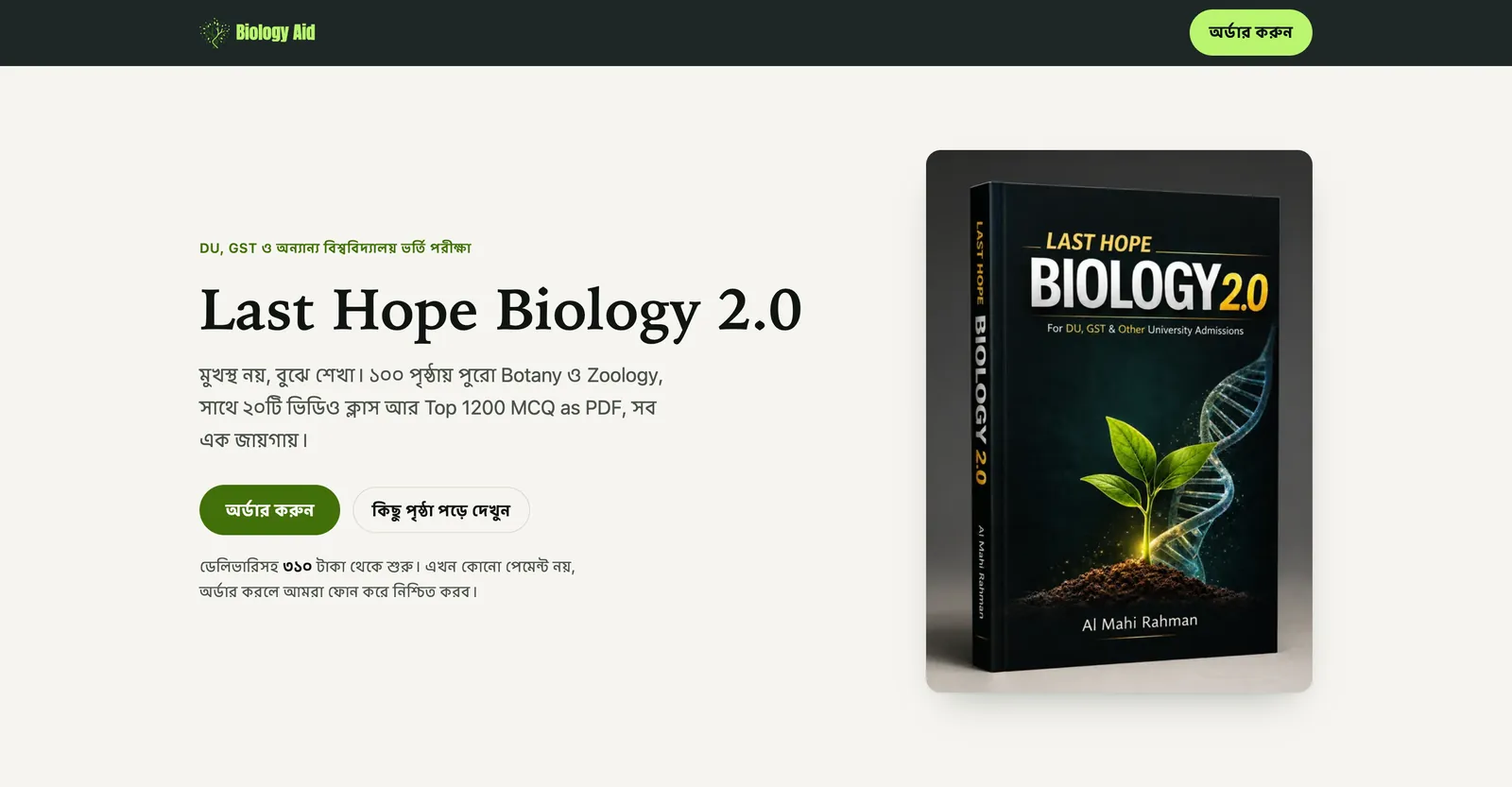
For comparison, the store I built for Biology Aid, a biology teacher's course and book store, is 23.5 KB for the whole page and loads in about 0.09 seconds. My own site, shahriaemon.com, scores 100 in Google's Lighthouse checks for accessibility, best practices and SEO. That is what careful building looks like, and it is the part a price list never shows.

The cost nobody quotes: monthly and yearly bills
Before you agree to any website, ask what you will pay every month or every year after launch. Common recurring costs are:
- Domain renewal, every year.
- Hosting, monthly or yearly. Bigger sites with databases and logins need more.
- Paid plugins or themes, which often renew yearly.
- Software subscriptions, like a shop platform or an email service.
Sometimes the cheapest way to cut these is to build less. On Biology Aid, the first plan had student logins, a database and an email service. I cut all of them, because Google Drive's per-email sharing protected the course videos better than a login would. The owner got more control and no monthly hosting bill. I explained that decision in detail in how to sell an online course in Bangladesh.
Three kinds of website worth paying for
I don't compete at the cheap end of the market. When someone asks me for a website, I offer clear options instead of a vague price range:
1. Basic: fast and simple, built to sell. A one-page or small site, built like Biology Aid. Mobile-first and fast on mobile data, a clean design, an order or contact form whose entries land in a Google Sheet or your email, and Facebook ads tracking set up properly. No login, no database, and no monthly hosting bill in most cases. Right for teachers, small shops and service businesses that take payment by phone.
2. Advanced: a premium site for your brand. Everything in Basic, with a design made for your brand instead of a simple layout, smooth animations, more pages, and sections you can update yourself. Right for businesses where the website is the first impression, and looking premium is part of what you sell.
3. Custom: a web app or full system. When you need things a website can't do: customer accounts, online payment gateways, an admin dashboard, a CRM, or automation behind the scenes. This is the kind of work I do for international clients, like the Project Nexus CRM and bot. Quoted per project after a short call.
Most local businesses need Basic or Advanced. If someone sells you Custom when you only need Basic, you will pay for it every month.
If you also want an AI chatbot that answers customer questions on your site, I add it as an optional one-time extra. The AI usage is billed to your own account, and I tell you that upfront, so there is no hidden monthly fee from my side.
How payment should work
Whoever you hire, the payment terms should protect you. Here is how I work, and it is a fair standard to ask any developer for:
- 50 percent advance to start.
- You see the finished site first. I build it on my own staging server and show it to you complete.
- The other 50 percent after you approve it, before it goes live on your domain.
- You get every login after the final payment: domain, hosting and site.
I don't charge for domain or hosting. I help you buy and set them up in your own name, so the website is fully yours.
Questions to ask any developer before you pay
- What exactly is included, page by page and feature by feature?
- What will I pay every year after launch, and to whom?
- Will the domain and hosting be in my name?
- How fast will it load on a phone using mobile data? Can you show me a site you built?
- Who fixes problems after launch, and how much does that cost?
- Do I see the finished site before the final payment?
A good developer answers all six without hesitating.
Want a quote that answers all six?
Message me on WhatsApp with what your business does and what you want the website to do. I'll tell you which option fits, what you'll pay now, and what you'll pay every year after. No surprises.