 Shahria Emon
Why I built it
I run a software company that works in AI, so I need to hear about industry-changing news fast.
Following dozens of outlets means wading through product reviews, deals, stock chatter and opinion pieces. I wanted a feed that interrupts me only when something actually matters, and only while it is still fresh. I built it for myself, then opened it to anyone.
What it does
It sends only the news that moves the industry: major AI releases, Big Tech acquisitions and strategy shifts, regulation and court rulings, mass layoffs and major breaches.
The bot watches 23 sources: 13 direct feeds (TechCrunch, The Verge, Ars Technica, Wired, CNBC, Bloomberg, FT, WSJ, BBC, The Guardian, MIT Tech Review, The Register and Google AI), 9 Bing News keyword searches and Hacker News.
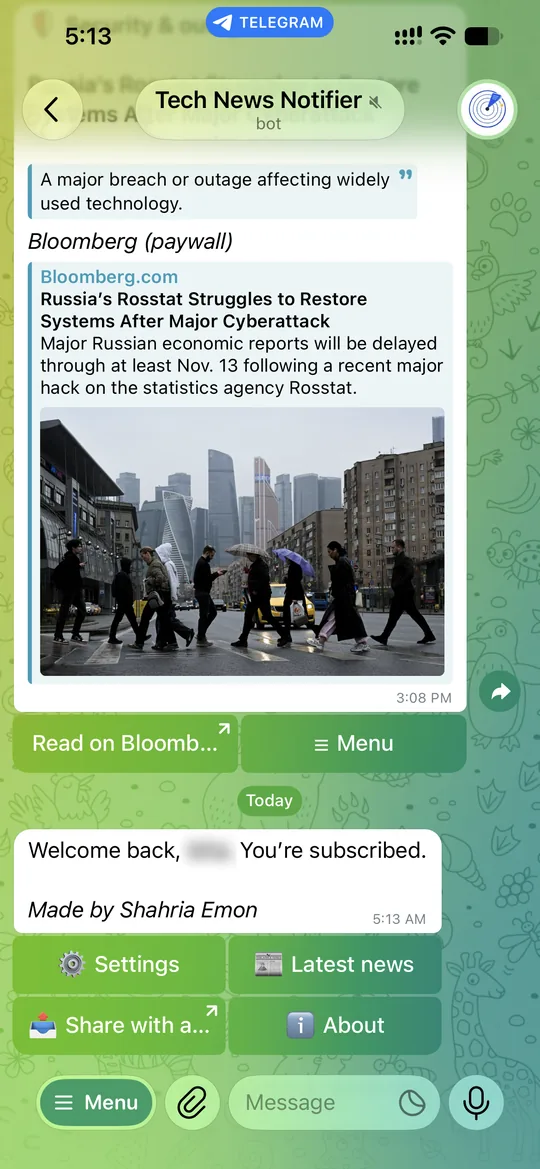
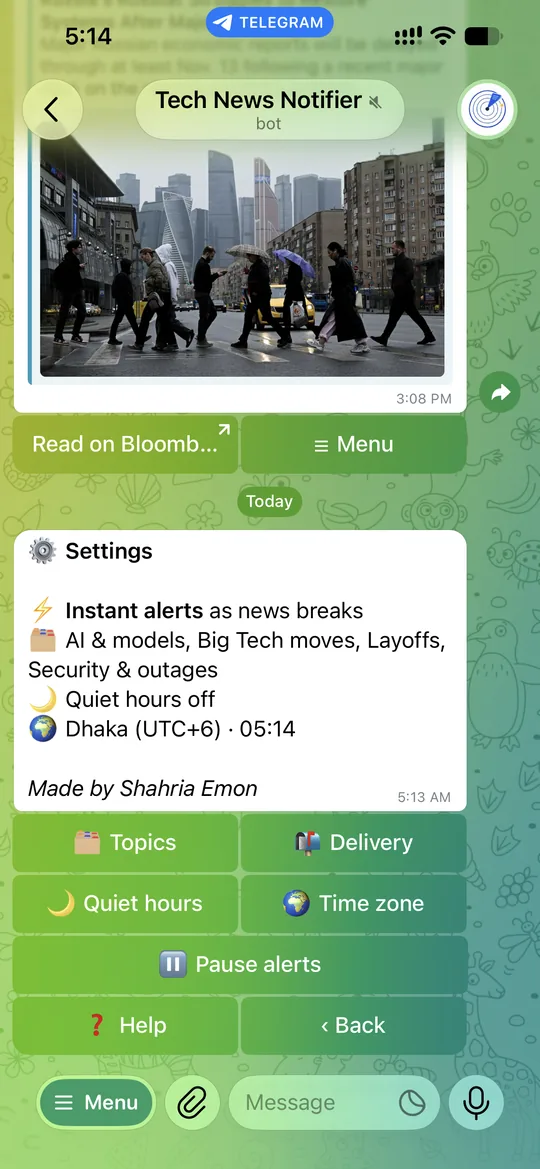
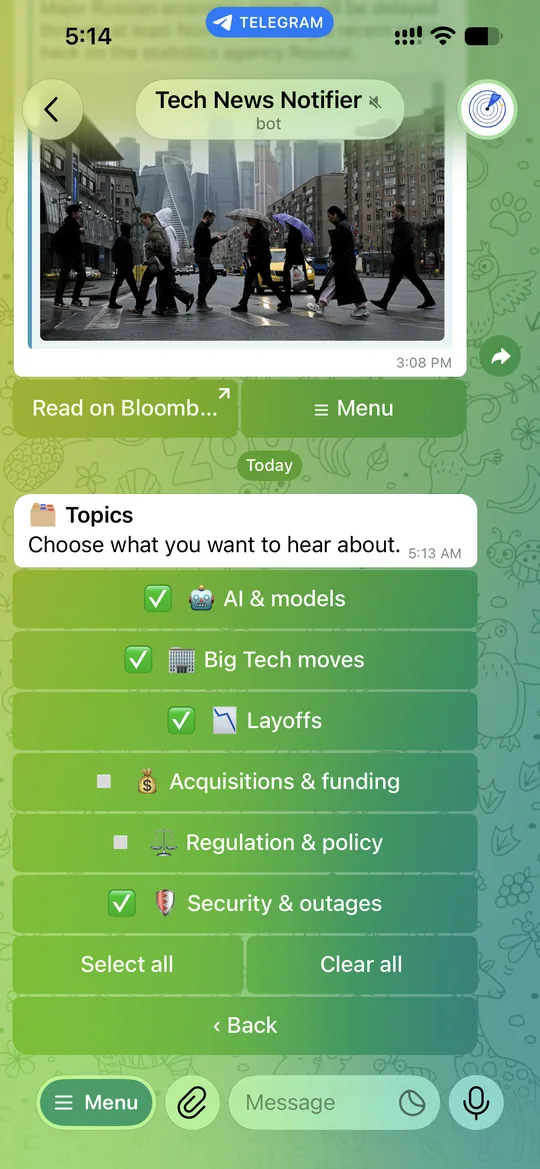
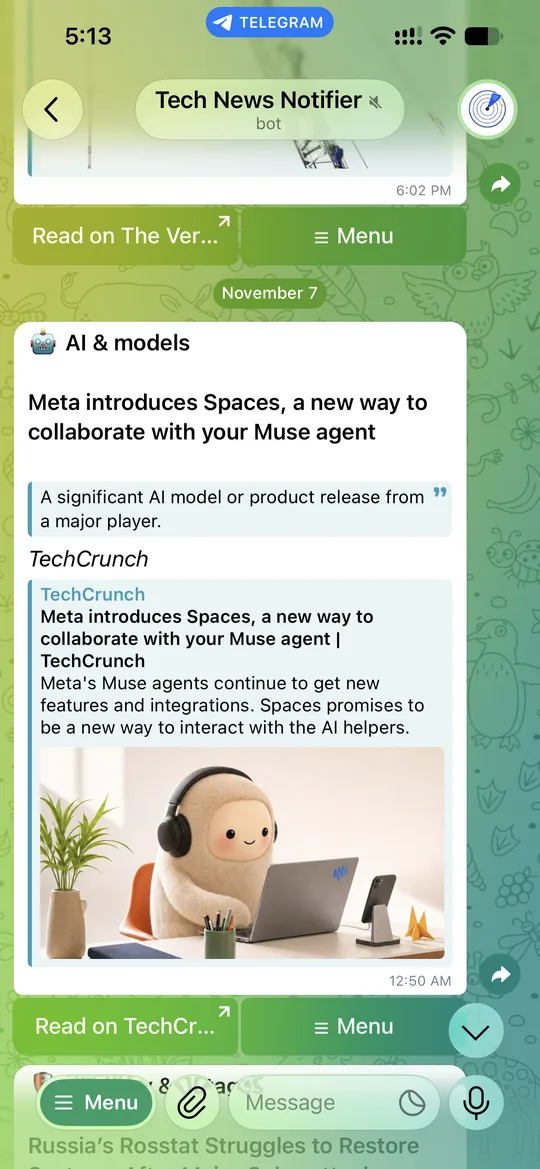
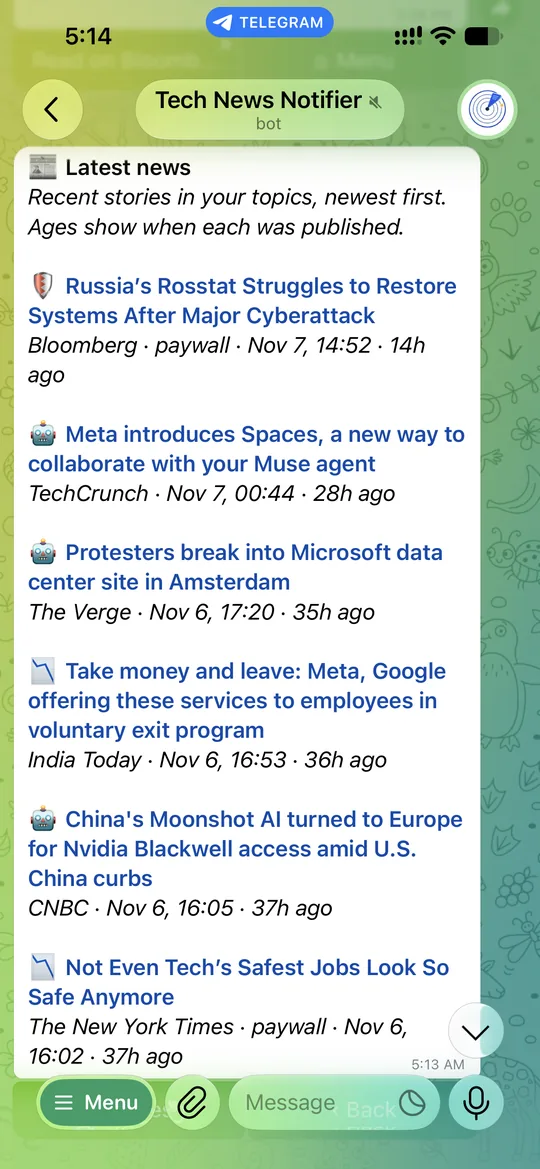
Each alert carries the headline, a category and one line on why it matters. When the same story is on Bloomberg and The Verge, the free source is the one linked. "(paywall)" appears only when no free source exists.
The chat stays clean. Menus edit one live panel in place and typed commands are deleted, so the chat holds only news.
How a headline becomes an alert
Each source is checked every 10 minutes, about 3,300 feed fetches a day.
In the last 14 days the bot took in about 8,500 headlines, roughly 600 a day:
868 dropped by the keyword pre-filter
5,525 rejected by the AI as not important
862 merged as duplicates of a story already seen
606 grouped into distinct stories
Of those, 413 scored too low or were never confirmed by a reputable outlet.
Speed
Measured per story across 147 stories.
- From the moment the bot first sees a story to the Telegram message: median 0 minutes (the same minute), 90th percentile 3 minutes. 93% are sent within 5 minutes.
- From the outlet publishing to the subscriber receiving it: median 17 minutes. For direct feeds the median is 13 minutes, and most of that is the outlet's own delay in updating its feed.
- Button taps answer in about 0.44 s, down from 0.9 to 1.2 s after optimisation.
Reliability
998 alerts delivered to real users in the last 30 days, with 0 failed and 0 waiting on retry.
An alert is marked sent only after Telegram confirms it. Network errors get up to 3 retries.
11 people subscribe today, all on instant alerts, most from a single Facebook post. The free tier has room for about 770 instant subscribers, and a built in waiting list handles anyone beyond that.
Running at $0: the 10 ms rule
Everything runs on Cloudflare's free tiers.
Daily usage against the free limits: about 6,600 of 100,000 Worker requests (about 7%), 4,000 to 8,500 of 100,000 database writes (5 to 8%), and 3,500 to 6,700 of 10,000 AI neurons on days the AI runs.
The free plan gives each request 10 ms of CPU. Running the whole pipeline in one request cost 15 to 54 ms. So a dispatcher runs every minute and starts each stage, and each feed, as its own request with its own CPU budget. A story first seen in a given minute is still classified and sent in that same minute.
| Stage | Median CPU |
|---|---|
| Dispatcher | 2 ms |
| Feed fetch | 6 ms |
| Classify | 2 ms (10 ms with an AI call) |
| Deliver | 4 ms |
A load test pushed 6,374 simulated messages to synthetic users in one day with Telegram mocked. It cut the cost per delivered alert from 6.5 to 3.5 database writes and from 41 to 17 reads.
What broke, and the fixes
Five problems, and how each was fixed.
"Breaking" news that was 4 to 16 hours oldA date parser checked against each publisher
Bing News labels its timestamps GMT, but they are actually US Pacific time, so every date was off by 7 hours. Bing also serves old articles in a new order, so they look fresh. Fixes: my own date parser, checked against each publisher's own published time; an instant alert only goes out if the story was published less than 3 hours ago; for Hacker News the date comes from the linked article, not the post.
I used up the whole database's daily write limit with my own stress testLocal load tests and a capacity monitor
Load tests against production used about 92,000 of the 100,000 daily writes, and writes failed until midnight UTC. Fixes: load tests now run locally only, writes per alert were cut almost in half, and a capacity monitor alerts me at 70% and 90% of any limit and switches to a saving mode at 85%.
The AI quota is shared across the whole Cloudflare accountA fallback that has run whole days on its own
Local test runs used up production's AI budget. Fixes: tests run without AI by default, and when the quota runs out the bot falls back to keyword rules plus anchor matching, which spots duplicates through shared numbers or model names such as "$40B" or "gpt-6". That fallback has run whole days on its own: Oct 30, Nov 1, 3, 5 and 7 had zero AI calls.
Weak stories from obscure outletsAn importance score, confirmation and a blocklist
Stock chatter and local news kept slipping in. Fixes: the AI scores importance from 1 to 5 and only 4 or higher is sent, a story from a low reputation outlet must be confirmed by a reputable one within 3 hours, and a blocklist covers SEO and stock chatter sites.
A cluttered chatOne live panel
Fix: the single live panel described above.
The AI
A classifier, a budget fallback, duplicate detection and a defence against prompt injection.
Classifier
Llama 3.3 70B on Cloudflare Workers AI in JSON schema mode. One call per batch of 3 headlines returns an importance score from 1 to 5, a category, a one line "why it matters", whether it is the same story as an existing one, and whether it is a major update.
Budget fallback
Llama 3.1 8B once the day's usage passes 6,000 neurons. Keyword rules take over at 8,500, or whenever the AI fails.
Duplicate detection
BGE small embeddings plus word overlap find candidates. Obvious duplicates (cosine 0.93 or higher) merge automatically and borderline cases go to the LLM. On average each story merges 2.4 source articles.
Prompt injection defence
Headlines are treated as untrusted data, unsafe characters are stripped and the output is strictly validated. If the AI's reason just repeats the headline, it is dropped.
Another write-up, on how it picks the news: building an AI news aggregator that sends only 2% of headlines.
Another Telegram bot I built: Project Nexus, a membership bot for a paid channel, and the write-up on removing members from a paid Telegram channel safely.
Build and tests
About 4,500 lines of TypeScript in 14 modules, 16 commits, 8 database tables across 5 migrations.
83 unit tests, a 104 check end to end suite (local database, mock feeds and a mock Telegram) and 12 live production checks.