 Shahria Emon
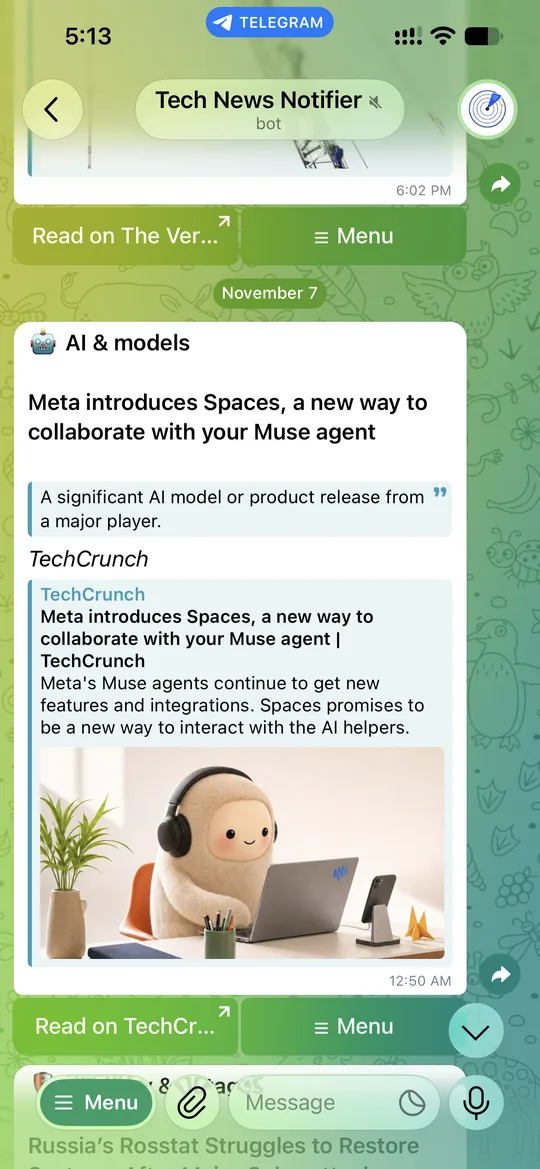
An AI news aggregator should save you reading, not create more of it. Most of them summarize everything they find, so you still get a flood, only shorter. I built one that does the opposite. Tech News Notifier reads about 600 tech headlines a day, keeps about 2% of them, and sends those to Telegram within minutes. Here is how it decides, with the real numbers.
What is an AI news aggregator?
An AI news aggregator collects stories from many sources and uses AI to decide which ones you should see. The good ones do three jobs: filter out what doesn't matter, merge the same story from different outlets into one, and deliver what's left while it is still fresh. Summaries are the easy part. Filtering is the hard part.
Why I built my own
I run a software company that works in AI, so I need to hear about industry-changing news fast. Following dozens of outlets meant wading through product reviews, deals, stock chatter and opinion pieces to find the few stories that actually change the industry.
Then Binance was hacked, the biggest crypto theft on record, and I heard about it half a day late, from a colleague. In my line of work that is too late. It happened the day after I started building this, and it showed me exactly what the bot had to fix.
So I built a feed that only interrupts me when something matters, and only while it is still fresh. I built it for myself first, then opened it to anyone.
How does an AI news aggregator decide what matters?
Mine runs every headline through four gates. Each one is cheaper than the next, so the expensive AI only sees what survives the cheap checks.
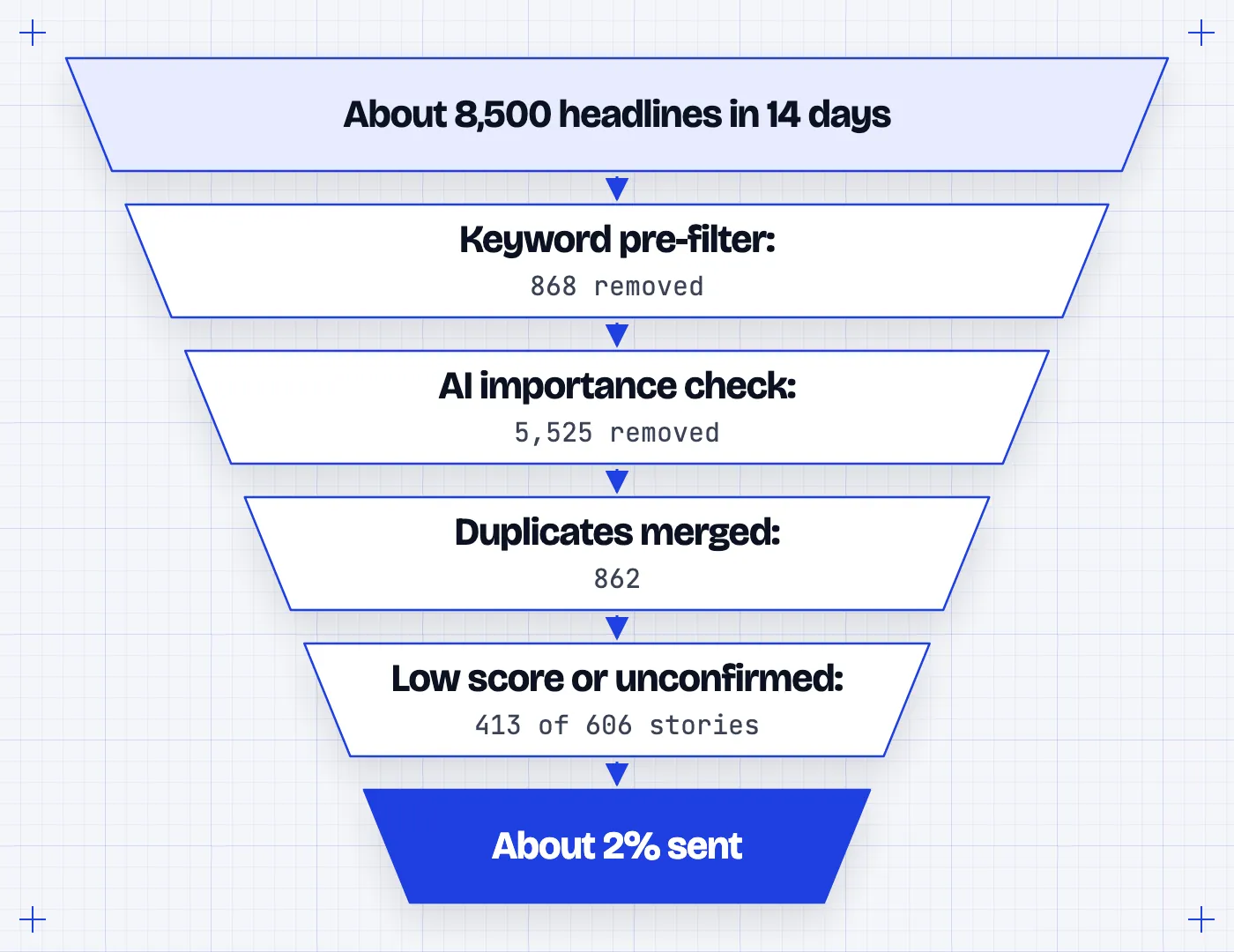
In the last 14 days the bot took in about 8,500 headlines from 23 sources. Here is where they went:
| Gate | Headlines removed |
|---|---|
| Keyword pre-filter | 868 |
| AI says not important | 5,525 |
| Merged as a duplicate of a story already seen | 862 |
| Grouped story scored too low or never confirmed | 413 of 606 stories |
About 2% of headlines become an alert. A normal day sends 4 to 18 stories.
The AI gate does most of the work. Llama 3.3 70B on Cloudflare Workers AI reads headlines in batches of 3 and returns, for each one, an importance score from 1 to 5, a category, a one-line reason it matters, and whether it is the same story as one already seen. Only a 4 or higher is sent.
How do you stop the same story arriving five times?
A big story shows up on TechCrunch, The Verge, Bloomberg and Hacker News within the hour. Without deduplication, you get the same news five times.
The bot turns each headline into an embedding (with the small BGE model) and checks word overlap against recent stories. Very close matches, cosine similarity 0.93 or higher, merge automatically. Borderline cases go to the language model to decide. On average, each story that reaches you is built from 2.4 source articles.
Merging also fixes paywalls. When the same story is on Bloomberg and The Verge, the alert links the free one. "(paywall)" only appears when no free source exists.
How fast can an AI news aggregator be?
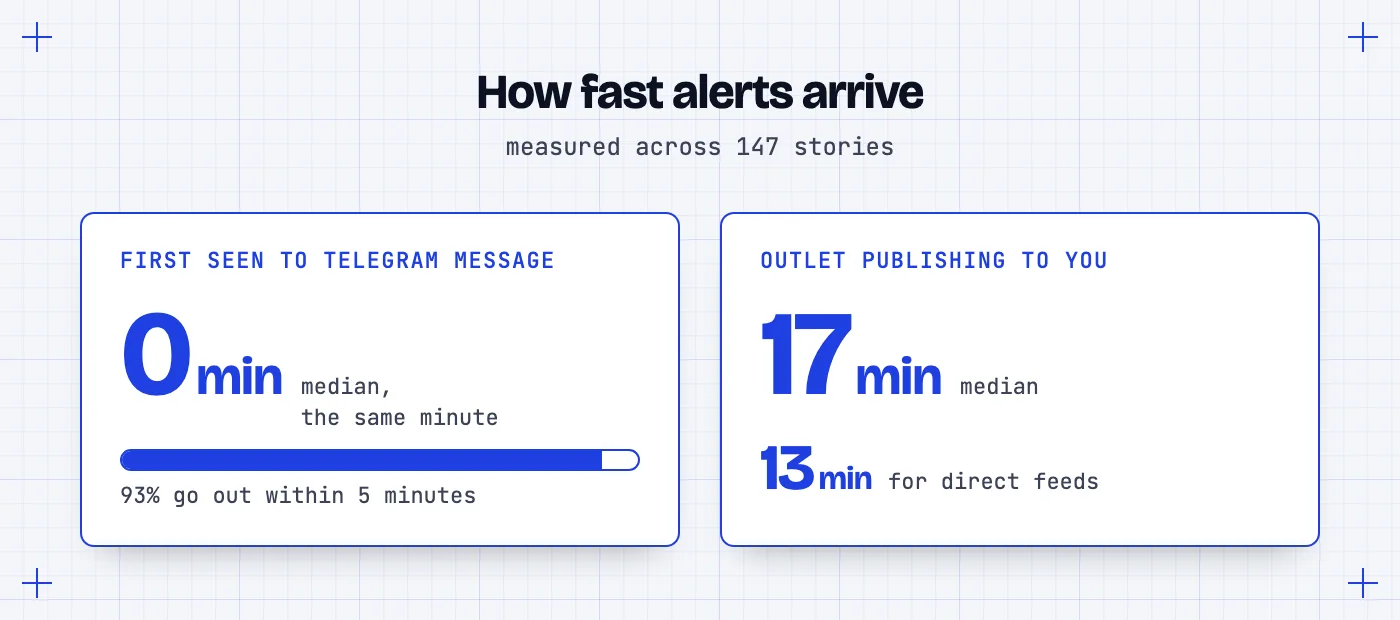
Fast enough that it beats checking the sites yourself. Measured across 147 stories:
- First seen to Telegram message: median 0 minutes, the same minute. 93% go out within 5 minutes.
- Outlet publishing to you receiving it: median 17 minutes. For direct feeds it is 13 minutes, and most of that is the outlet's own delay in updating its feed.
How do you keep junk and stale news out?
Two problems almost broke trust in the first week.
Stale "breaking" news. The first alerts were 4 to 16 hours old. Bing News labels its timestamps GMT, but they are actually US Pacific time, so every date was off by 7 hours. Bing also serves old articles in a new order, so they look fresh. The fix: my own date parser, checked against each publisher's published time, and a hard rule that an instant alert only goes out if the story is less than 3 hours old.
Weak stories from obscure outlets. Stock chatter and local news kept slipping through. Now a story from a low-reputation outlet must be confirmed by a reputable one within 3 hours, and a blocklist covers SEO and stock-chatter sites.
Can you trust AI with raw headlines?
Not blindly. A headline is text written by someone else, and it reaches the model as input. The bot treats every headline as untrusted data: unsafe characters are stripped, and the model's output is strictly validated against a schema. If the AI's "why it matters" just repeats the headline, it is dropped.
When the daily AI allowance runs low, the bot steps down instead of stopping: a smaller model after 6,000 neurons, then keyword rules at 8,500, with duplicates matched on shared numbers and model names such as "$40B" or "gpt-6". That fallback has run whole days on its own.
What does it cost to run?
Nothing. It runs entirely on Cloudflare's free tier, with no server. In 30 days it delivered 998 alerts to real users with 0 failures, and an alert is only marked sent after Telegram confirms it. The free tier has room for about 770 instant subscribers, and I wrote up every free tier limit it ran into and how each was fixed.
Should you build one or use one?
Build one now if knowing where your industry is going matters to your work. Every week without it is a week you hear the big news late, from someone else. Existing feeds give you everyone's priorities, not yours: you can't tell them which stories count, which sources you trust, or what is worth waking you up for. A custom aggregator answers those three questions your way.
If you want the feed itself, Tech News Notifier is free and open to anyone. The full build, stack and test suite are in the Tech News Notifier case study, and if your users live in Telegram, see how I handle members in a paid Telegram channel.
Need AI filtering for your own sources, whether news, listings or alerts? Message me on WhatsApp and tell me what it should catch.