 Shahria Emon
The Cloudflare Workers free tier limits look generous on paper: 100,000 requests a day, a free database, free AI. I run two production apps on that free plan, a Telegram news bot and an AI finance app, and four of those limits broke something in the first week. Here is each limit, what it actually did to a live app, and the fix that kept hosting at $0.
I picked Cloudflare because it is managed, reliable and free up to a point. For a new app with no users yet, that is the right place to start: no server to look after, and no bill until the app grows into one.
The two apps:
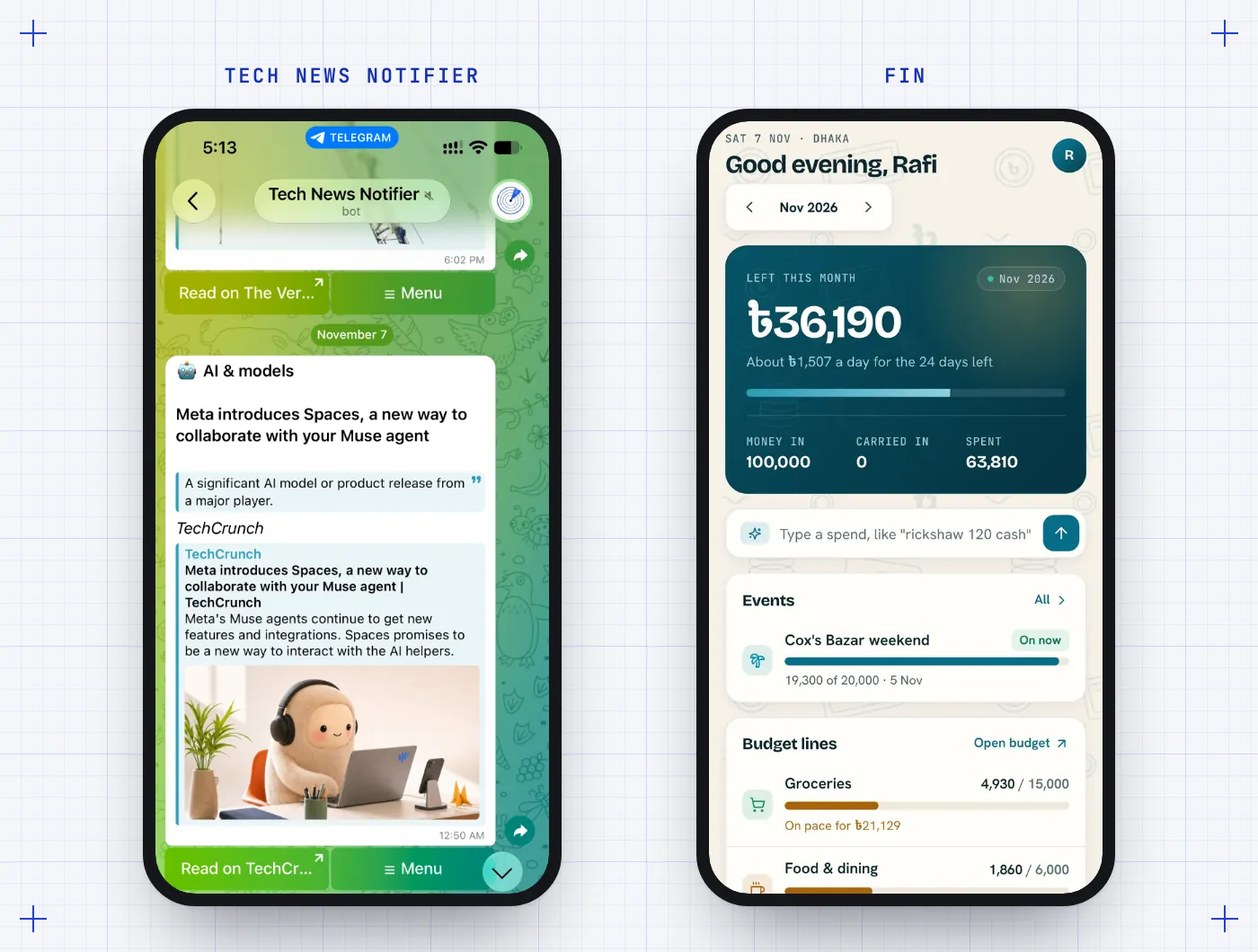
- Tech News Notifier watches 23 news sources, uses AI to keep only industry-changing tech news, and sends it to Telegram within minutes. Built solo with Claude Code in about two days. Try the bot on Telegram.
- Fin is a personal finance app. You type a spend the way you'd text a friend, in English or Banglish, and it files the right expenses, follows card cycles and answers questions about where the money went. Built solo with Claude Code in about three days. See Fin's landing page.
Cloudflare Workers free tier limits at a glance
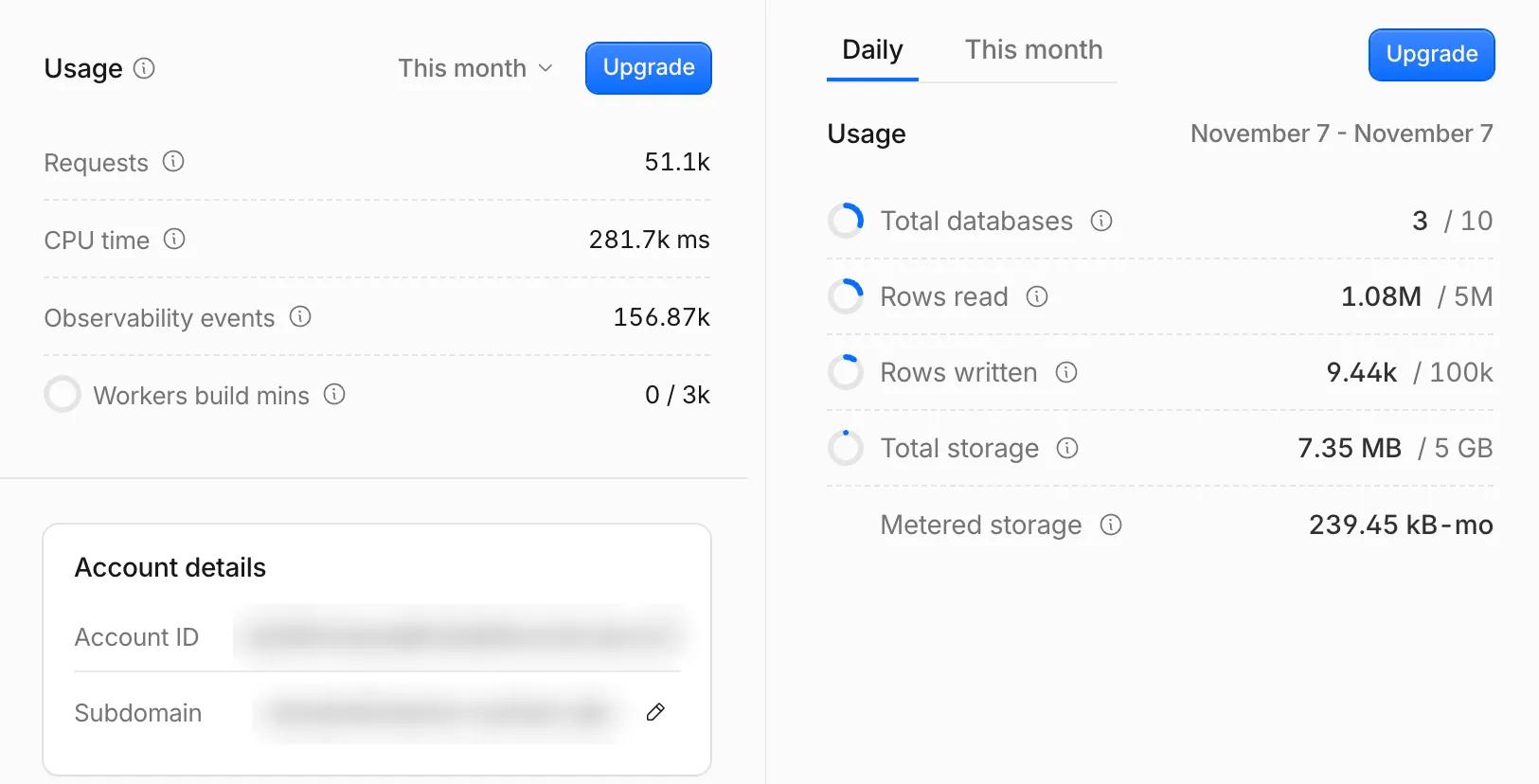
The Workers free plan gives you 100,000 requests a day and 10 ms of CPU time per request. D1, the database, allows 5 million rows read and 100,000 rows written a day, and 50 queries per Worker request. Workers AI gives 10,000 neurons a day for the whole account. Everything resets at 00:00 UTC.
| Limit (free plan) | Value | What happened in my apps |
|---|---|---|
| CPU time per request | 10 ms | News bot pipeline needed 15 to 54 ms. Had to split it. |
| Requests per day | 100,000 | News bot uses about 6,600 (about 7 percent). Fine. |
| D1 rows written per day | 100,000 | My own stress test used about 92,000. Writes failed until midnight UTC. |
| D1 queries per Worker request | 50 | Fin's syncs hit it. Now batched. |
| Workers AI per day | 10,000 neurons, shared by the account | Fin used it up on day one. Test runs drained the news bot's budget. |
What is the CPU time limit on the Cloudflare Workers free plan?
The free plan allows 10 milliseconds of CPU time per request. Time spent waiting on the network does not count, only time your code is actually computing. Parsing feeds, scoring headlines and building messages all count, so a pipeline that does several of these in one request can pass 10 ms quickly.
The news bot's first version did everything in one request every minute: fetch feeds, parse them, classify headlines, send alerts. That cost 15 to 54 ms of CPU per run. Five times the limit on a bad minute.
The fix was a dispatcher. It runs every minute on a cron trigger and starts each stage, and each of the 23 feeds, as its own request with its own 10 ms budget. A story first seen in a given minute is still classified and sent in that same minute.
| Stage | Median CPU per request |
|---|---|
| Dispatcher | 2 ms |
| Feed fetch | 6 ms |
| Classify | 2 ms (10 ms with an AI call) |
| Deliver | 4 ms |
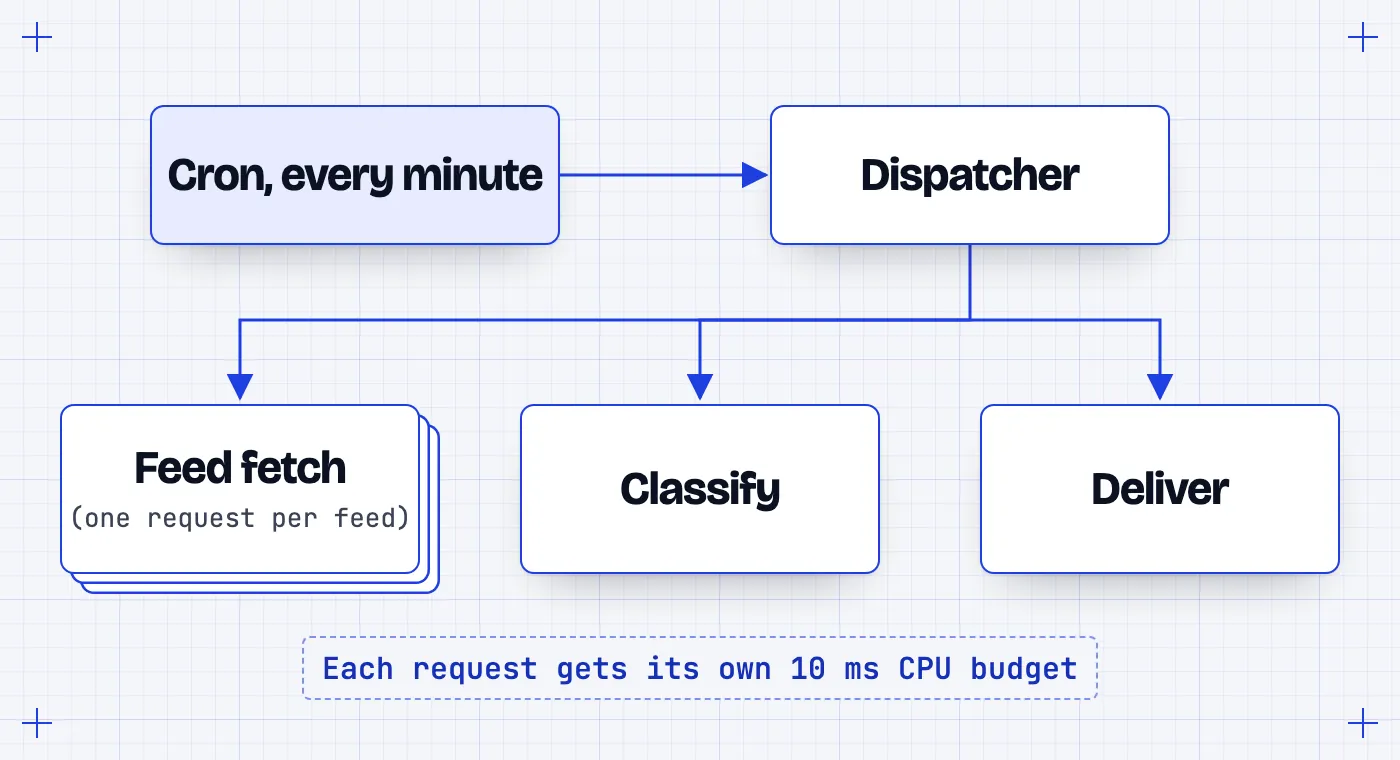
That limit shaped most of the architecture. If your Worker does real work per request, design for small units of work from the first commit, not after the errors start.
How many rows can you write to D1 per day on the free plan?
D1 on the free plan allows 100,000 rows written and 5 million rows read per day, plus 5 GB of storage across the account. Every insert, update and delete counts, and an index adds one more written row. When you pass the daily write limit, writes fail until the reset at 00:00 UTC.
I found this out with my own load test. I ran it against production, and it used about 92,000 of the 100,000 daily writes. For the rest of that day, writes failed.
Nobody was subscribed yet, so no real user was hurt. The bot itself told the story: it answered every tap by saying the server was busy and to try again later, and it stayed that way until the limit reset at midnight UTC.
Three changes came out of it:
- Load tests run locally only. The 6,374-message test now runs against a local database with Telegram mocked.
- Fewer writes per alert. Each delivered alert went from 6.5 database writes to 3.5, and from 41 reads to 17.
- A capacity monitor. It alerts me at 70 and 90 percent of any daily limit, and switches the bot into a saving mode at 85 percent.
On a normal day the bot writes 4,000 to 8,500 rows, about 5 to 8 percent of the limit.
How many D1 queries can one Worker request make?
On the free plan, one Worker request can run at most 50 D1 queries. The paid plan raises it to 1,000. This is the limit nobody plans for, because it doesn't show up in daily usage graphs. It only shows up when one request tries to do too much.
Fin hit it during sync. When the phone app comes back online, it sends everything entered offline, and the first version wrote each entry with its own query. A busy day of entries pushed one sync request past 50.
The fix is batching: group the statements and send them together, so one sync costs a handful of queries no matter how many entries it carries.
Is Workers AI free on the Cloudflare free plan?
Yes, with a daily allowance of 10,000 neurons that resets at 00:00 UTC. The catch is that the allowance belongs to the whole Cloudflare account, not to one Worker. Every app and every test run on the account draws from the same 10,000.
Both apps learned this the hard way.
Fin used up the free AI allowance on day one. That is why Fin has three layers for reading a typed entry: Claude Haiku first, then Llama 3.3 70B on the free Workers AI, then a simple built-in parser. If every AI is out, entries still save.
The news bot's test runs drained production's AI budget. Tests now run without AI by default. In production, the bot steps down as the day's usage climbs: Llama 3.3 70B normally, the smaller Llama 3.1 8B after 6,000 neurons, and keyword rules plus duplicate matching on shared numbers and model names at 8,500. On days the AI runs, it uses 3,500 to 6,700 neurons. The bot had zero AI calls on October 30 and November 1, 3, 5 and 7, and still delivered.
Both apps run on the same Cloudflare account, so they share one 10,000 neuron allowance. That is why the fallbacks matter: a busy day in one app can use up the AI for the other.
How many requests a day does the free plan allow?
The free plan allows 100,000 Worker requests a day. For most small apps this is the limit you will never hit. Splitting work into many small requests uses more of them, but even after the dispatcher split, the news bot uses about 6,600 a day.
That headroom is real capacity. By my numbers the bot can serve about 770 instant-alert subscribers before the free tier runs out. It has 11 today, and a waiting list is built in for anyone past the limit.
Reliability has not suffered for being free. In the last 30 days the bot delivered 998 alerts with 0 failures. An alert is marked sent only after Telegram confirms it, and network errors get up to 3 retries.
What it actually costs to run both apps
Cloudflare costs $0 for both. Fin's only paid part is the Claude API, which costs about 2 to 3 US cents per question in Ask Fin and about US$0.0006 per typed entry with Claude Haiku. A built-in monthly cap of US$10 switches Fin to the free model when it is reached.
So the free tier is not the whole bill if you use a paid model, but it carries everything else: hosting, database, scheduled jobs and a backup AI.
When the free tier stops being enough
I will move to the $5 Workers Paid plan when two things are true: the apps are actually reaching a limit, and there is a real user base behind that usage. Paying before then buys headroom nobody is using. With room for about 770 instant subscribers on the news bot alone, the free plan has plenty of runway left.
What I'd tell anyone building on the free plan
- Design for 10 ms from day one. Small requests, one job each.
- Never load test against production. The daily limits are account-wide and do not care that it was a test.
- Batch your D1 writes. It saves you from the 50-query cap and the daily write limit at the same time.
- Treat free AI as a bonus, not a dependency. Build the fallback before you need it.
- Watch your own usage. A monitor at 70 percent beats finding out from users.
The full builds are in the Tech News Notifier case study and the Fin case study. Both apps were built with Claude Code using the same spec-first approach I used to rebuild Scrumo's core in 7 days. The Scrumo case study shows that workflow on a bigger product, and if your bot lives in Telegram, here is how I handle removing members from paid channels.
Building something that has to run cheaply and stay up? Message me on WhatsApp and tell me what it needs to do.