 Shahria Emon
Most Claude Code best practices lists are about commands and settings. Those help, but they are not what decides whether a build ends up in production. In the last few weeks I built and shipped three projects on my own with Claude Code: a Telegram news bot in about two days, a finance app in about three, and the rebuild of this website. These are the eight habits that made the difference, each with what it caught.
What are the most important Claude Code best practices?
Plan before you build, define what "done" means, test the rule rather than the example, keep tests away from production, and make Claude Code prove every number it reports. Speed comes from Claude Code. Correctness comes from these habits.
Some background: I started coding in 2020, in browser automation. When I became COO, I stepped away from code for about a year. In 2023 I came back through Solana development, and I've kept coding since, alongside running operations and leading developers. So I've watched the industry change from up close. What surprised me most about building with AI: it feels like always having an active, capable developer who delivers, as long as I explain clearly what I need.
1. Prototype before you build
Fin's first day had no production code. It was design and a clickable prototype. Day two was the build, the data migration and the landing page. Day three was the finishing work.
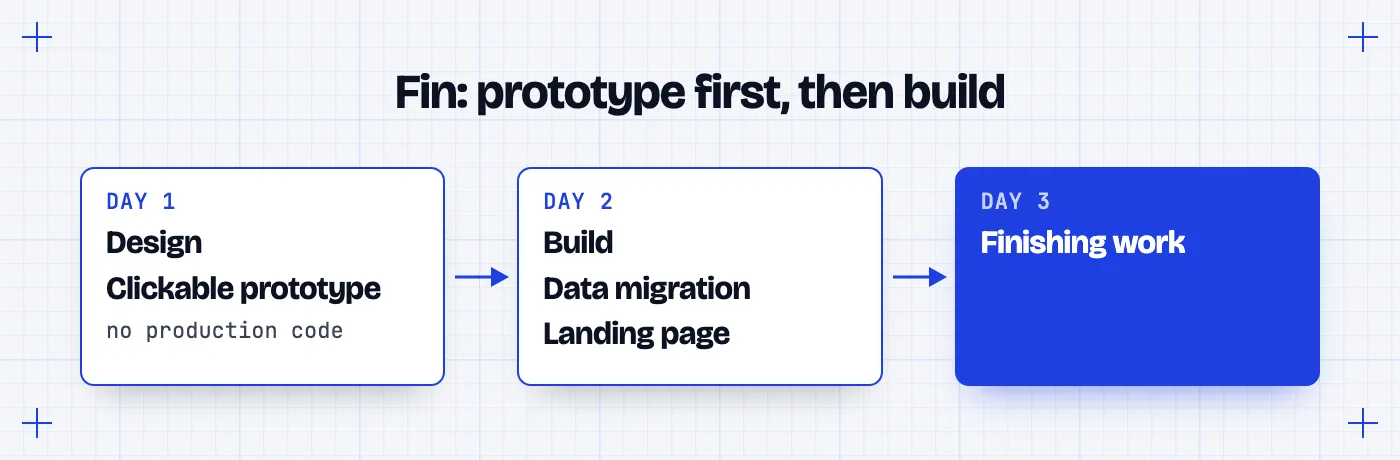
Seeing the screens first settles most of the questions that would otherwise come up halfway through the build, when changing them is expensive. Claude Code is fast enough that a prototype costs hours, not weeks.
2. Write the plan down before the code
Give Claude Code a written spec: what the feature does, what is out of scope, and how you will check it works. I wrote about this approach in detail in spec-driven development on a real project. The short version: time spent sharpening the plan saves more than time spent watching the build.
3. Define "done" as "verified live"
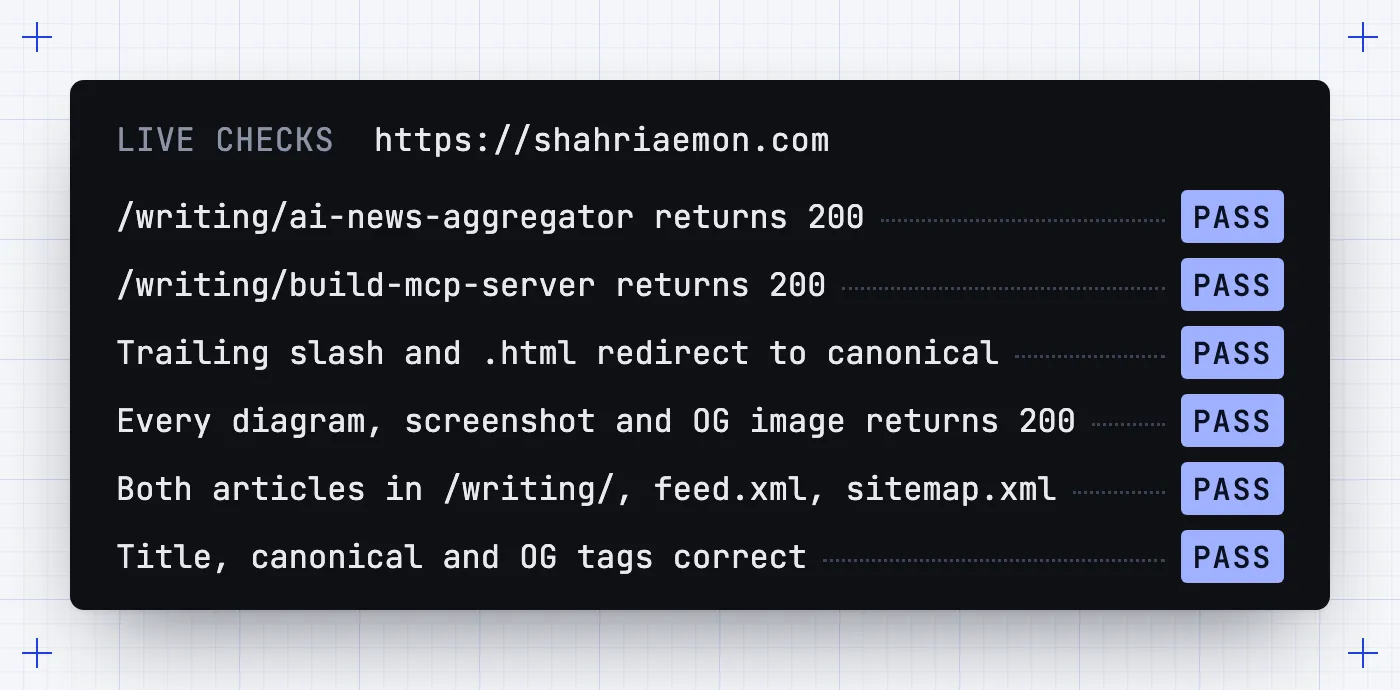
Every build prompt I give Claude Code ends with a definition of done that includes the live site, not just the code. For this website, that means the page returns 200, the trailing-slash variant redirects to the canonical URL, every image loads, and PageSpeed is checked on the live page. Claude Code does not stop at "it builds"; it stops when the live checks pass, and fixes and redeploys if they don't.
4. Test the rule, not the example
Fin follows credit card cycles: each card has its own closing and due days, and a charge counts on the day it is spent. A few test cases would have passed easily. Instead, the card rule was checked against every single day from 2026 to 2028. Edge cases like month ends and leap days stop being a worry when every day is tested.
The same goes for data. When Fin replaced my old tracker, the migration was checked month by month against the old totals. Every month matched, with 0 differences.
5. Mock the outside world
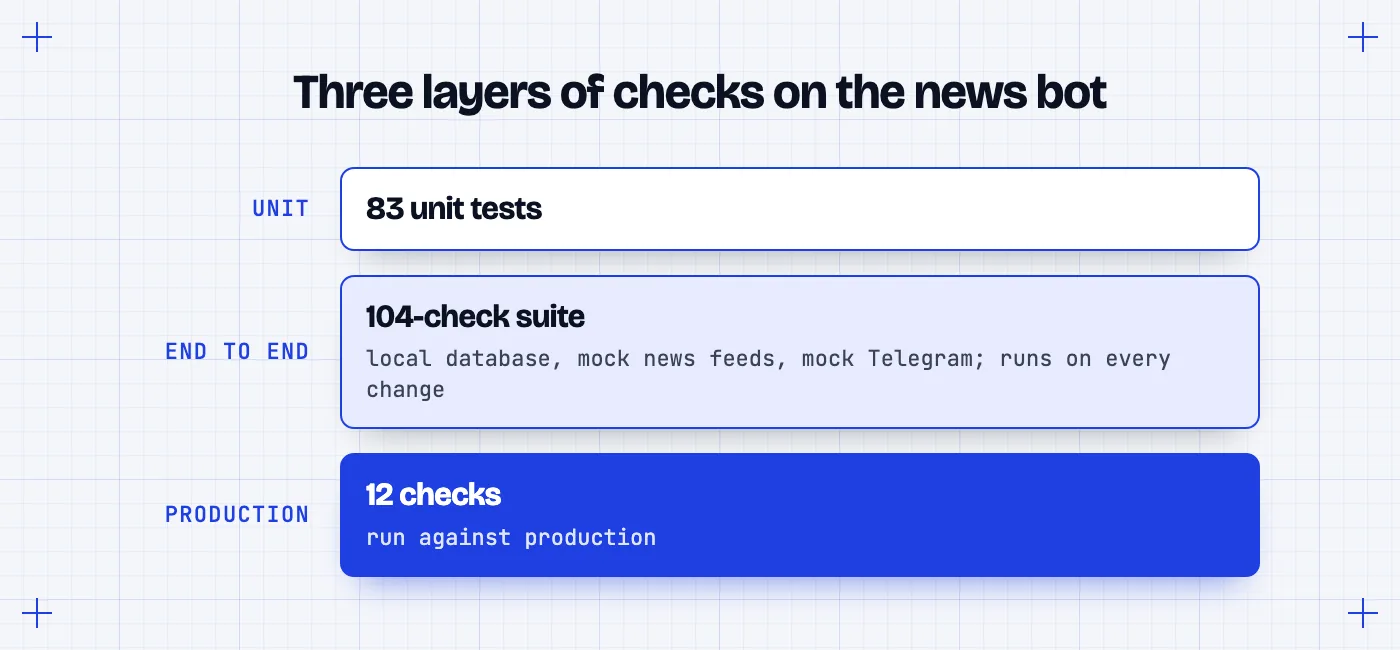
The news bot has 83 unit tests and a 104-check end-to-end suite that runs against a local database, mock news feeds and a mock Telegram. On top of that, 12 checks run against production. The end-to-end suite means the whole pipeline, from headline to alert, is tested on every change without touching real services.
6. Keep tests away from production
The hard way: my own stress test, run against production, used about 92,000 of the database's 100,000 daily writes, and writes failed until midnight UTC. Separately, local test runs used up production's daily AI allowance, because the allowance is shared across the whole account.
Now load tests run only locally, and tests run without AI by default. Ask Claude Code to make the safe path the default, so a test can't touch production by accident.
7. Build the fallback before you need it
Fin's free AI allowance ran out on day one of the build. Because of that, Fin has three layers for reading a typed entry: a Claude model, a free model, then a simple built-in parser. The news bot does the same with a smaller model and then keyword rules, and it has run whole days with no AI at all. Ask Claude Code, at planning time, what happens when each outside service fails.
8. Make it prove every number
At the end of a build I ask Claude Code for a report with measured numbers only. It is good at saying what it could not measure. Fin's report said plainly that uptime isn't measured, so no uptime figure should be claimed. A report that admits gaps is one you can trust for everything else.
One more habit, and it's the one I'd give anyone starting tomorrow: when Claude Code says it's done, challenge it to look again. Ask it to re-check its own work against what you asked for. The second look regularly finds what the first one missed.
What these habits produced
- Tech News Notifier: about 4,500 lines of TypeScript in 14 modules, 998 alerts delivered in 30 days with 0 failures, $0 a month to run.
- Fin: about 4,300 lines, Lighthouse mobile from 74 to 98, migration with 0 differences.
- This website: every article in the writing section built, checked and deployed by Claude Code from a single prompt.
The full stories are in the Fin case study and the Tech News Notifier case study. For the infrastructure side, see Cloudflare D1 in production.
Want an app built this way, fast and verified? Message me on WhatsApp and tell me what you need.