 Shahria Emon
Most Claude Haiku vs Sonnet comparisons are benchmark tables. Benchmarks don't tell you which one to put behind a button your users press twenty times a day. I use both models in the same app, for different jobs, and measured each one. Here is what that looks like in production, and the simple rule I use to choose.
Claude Haiku vs Sonnet: the short answer
Use Haiku for small, frequent, well-defined jobs where speed and cost per call matter: reading a short input and returning structured data. Use Sonnet for open questions that need reasoning over a lot of context, where a better answer is worth a few more seconds and a few more cents. In most apps, the right answer is both.
Where I use each one
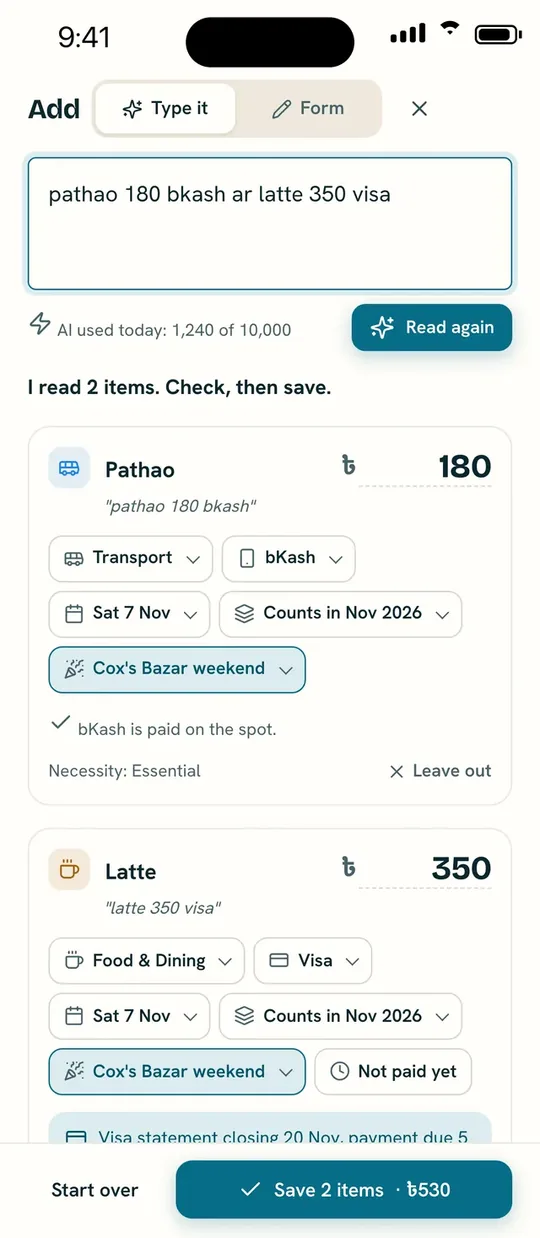
Fin is my personal finance app. You type a spend the way you'd text a friend, for example "aj rickshaw 120 cash, bajar 2450 visa", and Fin turns it into the right expenses. You can also ask it questions about where the money went. Those are two very different AI jobs.
| Typed entry | Ask Fin | |
|---|---|---|
| Model | Claude Haiku 5.5 | Claude Sonnet 5.5 |
| Job | Turn one short message into expenses | Answer an open question about your money |
| Input | One line, often in Banglish | A cached summary of all your data, about 9,000 tokens |
| Output | Structured data the app checks | A written answer |
| Time | About 3 seconds | 8 to 18 seconds |
| Cost | About US$0.0006 | About 2 to 3 US cents |
Why Haiku is right for typed entries
A typed entry is the most frequent thing anyone does in Fin. It needs to feel instant, and it happens many times a day, so cost per call adds up.
The job is also narrow. Haiku reads one short line and returns structured output: amount, category, payment method, date. That fixed shape makes the task easy for a smaller model and easy for the app to check. If something doesn't fit, the app catches it before anything is saved.
Language matters too. Entries mix Bangla words written in English letters with English ones, like "bajar" for groceries. Haiku handles that reliably for this kind of short input.
A single line like "aj rickshaw 120 cash, bajar 2450 visa" holds two expenses, two payment methods and two languages. Haiku splits it into two separate entries, each with the right amount, category and card or cash, ready for me to confirm.
Why Sonnet is right for questions
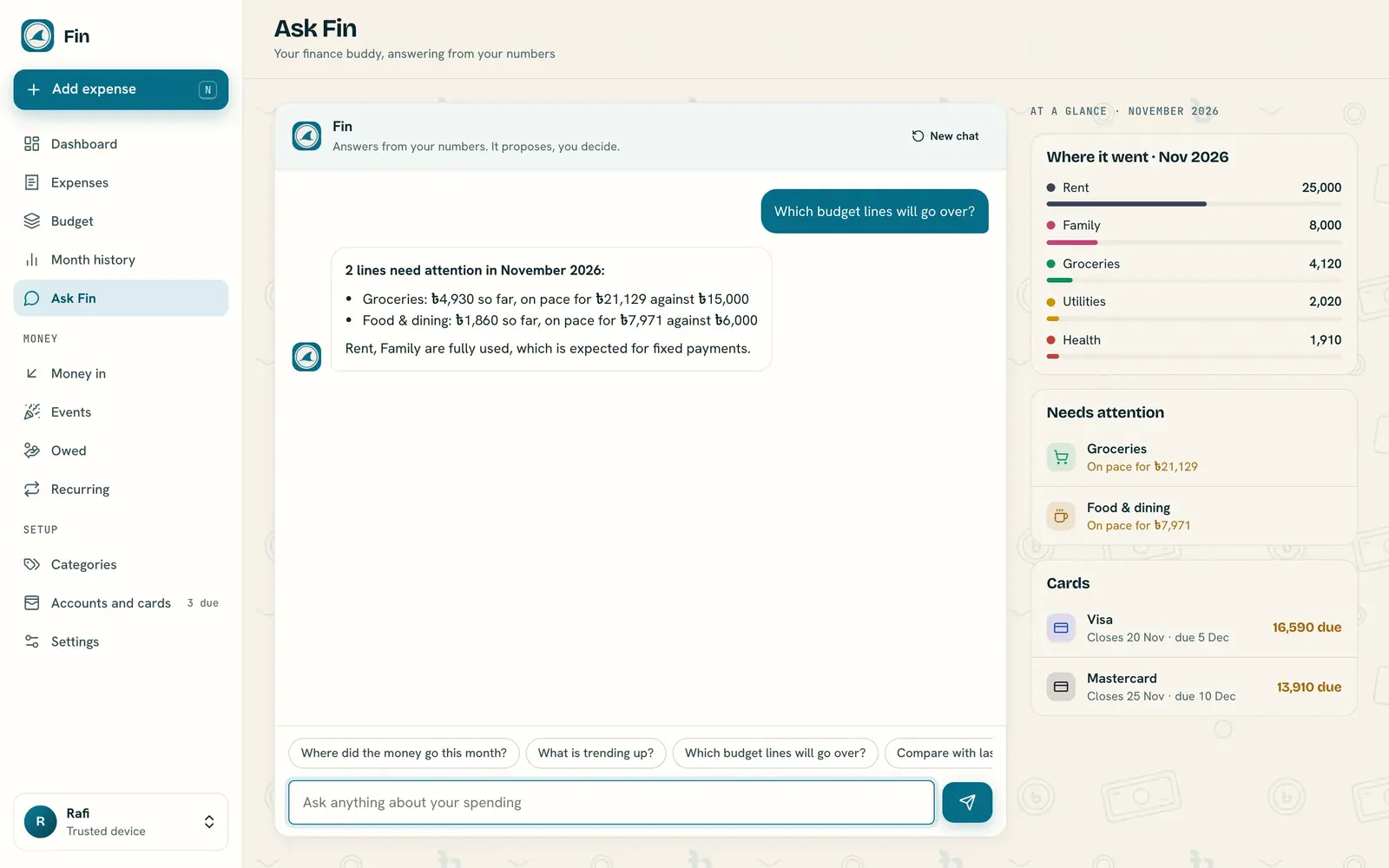
Ask Fin is the opposite job. A question like "where did the extra money go this month?" has no fixed shape. To answer it, the model reads a summary of everything: budgets, card cycles, trips and spending patterns, about 9,000 tokens. Then it has to reason across all of it and explain the answer in plain words.
That is where Sonnet earns its cost. A question is asked far less often than an entry is typed, so 2 to 3 cents per answer stays small. And a slow, good answer beats a fast, wrong one when someone is trying to understand their own money.
How do you keep AI costs under control?
Pick the model per feature, not per app, then put a ceiling on the total.
Fin has a built-in monthly cap of US$10 on the Claude API. When it's reached, Fin switches to a free model for the rest of the month instead of stopping. That fallback is Llama 3.3 70B on Cloudflare's free Workers AI, and behind that a simple built-in parser, so a typed entry always saves. The free AI allowance ran out on day one of the build, which is why those layers exist.
The other half of cost control is caching. Ask Fin reads a summary of your data, not your raw history, and that summary is cached. Every question doesn't rebuild it from scratch.
Should AI ever change your data on its own?
Not in Fin. Whichever model runs, the AI proposes and you confirm. It never changes budgets or saved records by itself. That rule matters more than the model choice: a cheaper model with a confirm step is safer than a smarter model with direct write access.
A simple rule for choosing
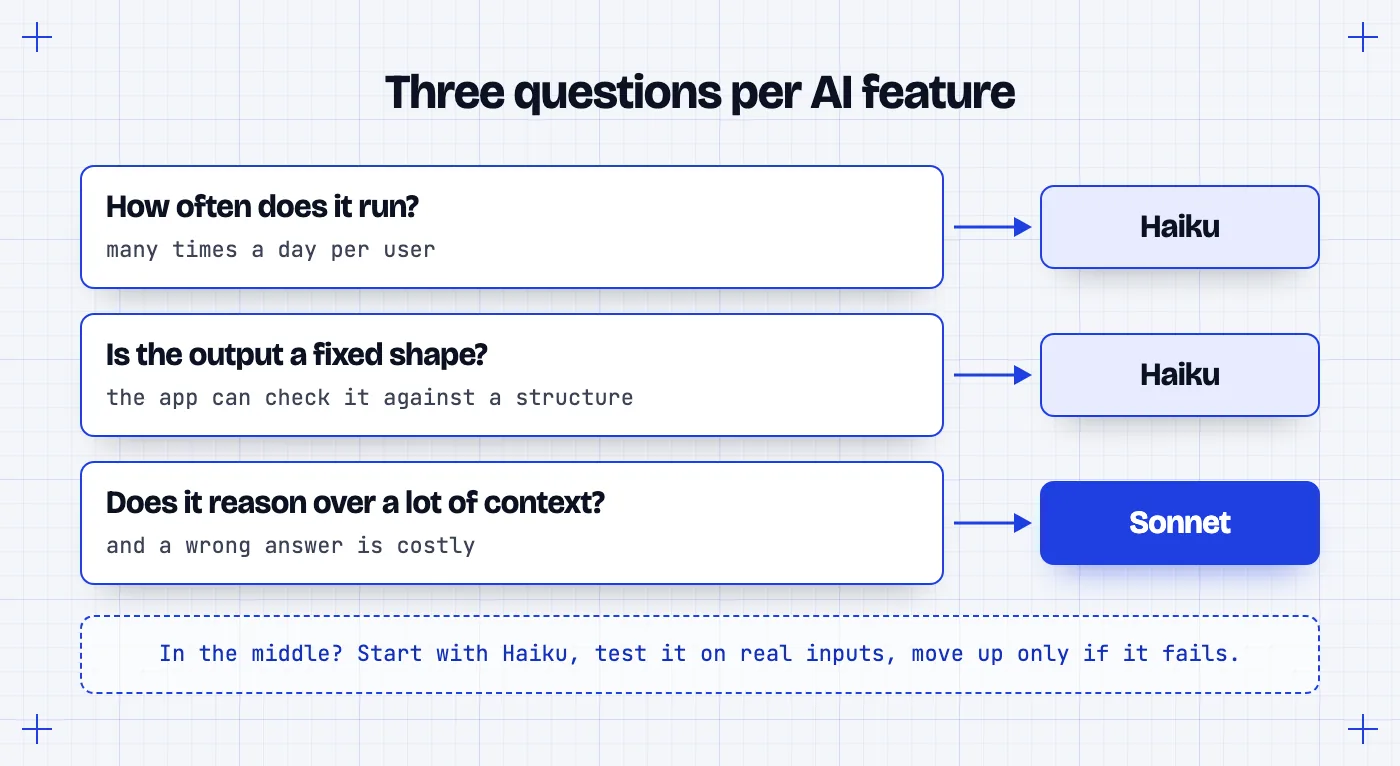
Ask three questions about each AI feature:
- How often does it run? Many times a day per user points to Haiku.
- Is the output a fixed shape? If the app can check the result against a structure, Haiku is usually enough.
- Does it need to reason over a lot of context? If yes, and a wrong answer is costly, use Sonnet.
When a feature sits in the middle, start with Haiku, test it on real inputs, and move up only if it fails. Measure time and cost per call from the first day, the way the table above does.
For the hosting side of the same app, here is what happened when Fin and my news bot hit Cloudflare's free tier limits.
Building an AI feature and not sure which model belongs behind it? Message me on WhatsApp and tell me what it needs to do.